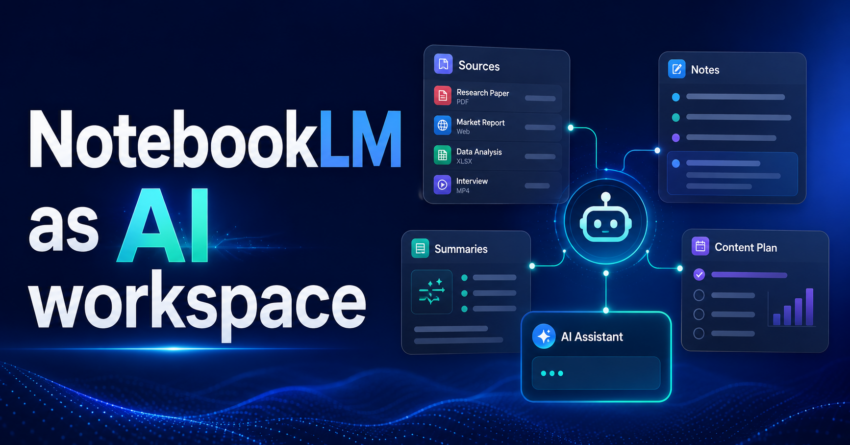
I use NotebookLM for content marketing as my central AI workspace. Not as a random chatbot. Not as a one-time writing assistant. I use it as a source-based workspace where my research, blog briefs, SEO notes, content ideas, competitor pages, and repurposing plans stay connected.
This matters because solo content marketing has too many moving parts.
After all, solo content work is not just writing.
It is research, planning, SEO, positioning, drafting, editing, repurposing, publishing, and refreshing old content. If all of that sits across browser tabs, Google Docs, notes apps, spreadsheets, and chat history, the workflow becomes messy fast.
As a result, NotebookLM helps me turn scattered research into a simple content marketing system.
Quick Answer: How I Use NotebookLM for Content Marketing
I use NotebookLM as an AI workspace for marketers by creating topic-based notebooks. Inside each notebook, I upload sources like research articles, competitor pages, transcripts, old blogs, keyword notes, and campaign ideas. Then I use NotebookLM to create SEO briefs, blog outlines, content angles, FAQs, LinkedIn posts, newsletter ideas, and repurposing plans from the same source library.
In simple words:
NotebookLM becomes my content marketing knowledge base.
Why I Needed a Central AI Workspace
In my experience, most solo marketers do not have a content problem. They have a content operations problem.
Research, strategy, and execution are scattered everywhere.
The research is in one place. The keyword notes are somewhere else. The draft is in a document. The LinkedIn ideas are in a separate note. The competitor examples are open in ten browser tabs. The content calendar is in a spreadsheet.
A solo content workflow usually looks like this:
Then, we expect AI to magically make everything easier. But a blank AI chat often gives blank-page thinking.
The blank AI chat problem
You ask one prompt, get one answer, copy it, and start again the next day. That works for quick tasks.
The workspace approach
However, it does not work for a serious solo content marketing workflow. You need one place where context stays connected.
I needed one place where I could keep:
That is why NotebookLM fits into my workflow.
The biggest problem is not writing.
The biggest problem in solo content marketing is keeping research, strategy, and execution connected. NotebookLM gives me a central AI workspace where that connection becomes easier to manage.
What NotebookLM Does Differently From a Normal AI Chatbot
Starts with a prompt
A normal AI chatbot usually begins with whatever you type in that moment. So, every time you start again, you often need to explain the context again.
Starts with your sources
NotebookLM begins with the material you add to the notebook. As a result, the AI works from your research, notes, pages, and documents.
That difference changes the workflow.
The AI is working from your material, not just a blank prompt. That means you spend less time repeating context and more time building on what you already know.
Without source context
The output can feel generic because the AI is responding mainly to the prompt, not to your full research base.
With NotebookLM
I can build a notebook around one topic and keep the source material inside it. That makes the output more grounded and helps me avoid generic AI content.
| Normal AI Chatbot | NotebookLM |
|---|---|
| Starts with a prompt | Starts with your sources |
| Good for quick answers | Good for source-based thinking |
| Outputs can feel generic | Outputs stay closer to your material |
| Chat history gets messy | Notebooks keep topics organized |
| Better for one-off tasks | Better for ongoing content systems |
Therefore, I do not think of NotebookLM as only an AI research assistant.
I think of it as a working space.
In other words, it becomes a place where one topic can grow over time.
My NotebookLM Setup for Content Marketing
First, I do not put everything into one giant notebook. Otherwise, the workspace becomes messy.
Instead, I create notebooks based on the job I want them to do.
| Notebook Type | What I Store Inside | How I Use It |
|---|---|---|
| Blog topic notebook | Research links, competitor pages, keyword notes | Build blog outlines and SEO briefs |
| Brand voice notebook | Past posts, writing rules, tone examples | Keep content consistent |
| SEO research notebook | SERP notes, FAQs, keyword clusters | Improve search visibility |
| Repurposing notebook | Published blogs, LinkedIn posts, newsletters | Create social and email ideas |
| Product or service notebook | Website pages, decks, FAQs, positioning notes | Create landing pages and campaigns |
| Swipe file notebook | Hooks, examples, frameworks | Improve creative quality |
Because of this setup, my content system stays cleaner and easier to manage.
For example, if I am writing a blog on AI tools for marketers, I create a dedicated notebook for that topic. I add competitor blogs, official product pages, my notes, keyword ideas, and my own point of view.
Then I ask NotebookLM to help me analyze the topic before I write.
However, that last part is important.
I do not ask NotebookLM to write first.
I ask it to think first.
My Solo Content Marketing Workflow With NotebookLM
Here is the simple workflow I follow.
| Content Stage | What I Add to NotebookLM | What I Ask NotebookLM to Do |
|---|---|---|
| Research | Articles, sources, competitor pages, transcripts | Summarize patterns and gaps |
| SEO planning | Keywords, SERP notes, FAQs, headings | Build an SEO brief |
| Angle selection | Audience pain points, examples, notes | Suggest strong hooks and angles |
| Blog outlining | Research notes, brief, personal POV | Create a structured outline |
| Draft support | Outline, source notes, examples | Expand sections with context |
| Repurposing | Final blog, LinkedIn examples, audience notes | Create posts, snippets, emails |
| Refreshing | Old blog, new sources, updated notes | Find outdated sections |
This workflow keeps everything connected because each stage builds on the previous one.
First, research becomes the brief.
Then, the brief becomes the outline.
After that, the outline becomes the draft.
The draft becomes LinkedIn posts, carousel ideas, email angles, and short snippets.
Finally, one idea turns into multiple content assets.
How I Use NotebookLM Across the Content Marketing Process
This is the practical workflow I follow to turn research into briefs, angles, outlines, repurposed content, and a reusable content knowledge base.
I Use NotebookLM as a Research Library
Before writing any serious blog, I collect sources first.
This can include:
Once the sources are ready, I ask NotebookLM questions like:
- What are the common themes across these sources?
- What is repeated too often?
- What is missing from these articles?
- What would a senior marketer care about here?
- What are the strongest practical insights?
- What angle would make this blog different?
As a result, I avoid writing the same blog everyone else is writing.
Most content fails because it has no angle.
NotebookLM helps me see what the market is already saying. Then, I can decide what I want to say differently.
I Turn Research Into an SEO Brief
Once I understand the topic, I use NotebookLM to create a working SEO brief.
My prompt usually looks like this:
This gives me a working brief.
However, I do not blindly accept it. That is where marketer judgment matters.
NotebookLM can support SEO research, but it does not know my business goals perfectly. It does not know which keyword has the best revenue value. It does not know which angle fits my personal brand unless I tell it.
So, I treat the output as a starting point.
Then I refine:
AI can speed up the brief. It should not replace the strategy.
I Use NotebookLM to Find the Strongest Angle
For me, this is one of the most useful parts of the workflow.
Before drafting, I ask:
- What is the most overused advice in these sources?
- What would a senior marketer disagree with here?
- Give me 5 stronger angles than a generic how-to article.
- What is the most practical angle for a solo marketer?
- What is the one-line thesis for this blog?
This is how I get beyond generic content.
For example, the angle for this blog is not: “How to use NotebookLM.” However, that is too broad.
The stronger angle is: “How I use NotebookLM as my central AI workspace to run a solo content marketing operation.”
Instead, this angle is more specific. It has a clear audience. It has a practical promise. It also sounds like real experience, not a recycled tutorial.
I Build Blog Outlines From Source-Based Notes
After the angle is clear, I ask NotebookLM to help structure the blog.
My outline prompt is usually:
Then, I manually improve the outline.
Next, I check whether the H2s answer real search questions.
The outline is where the blog either becomes useful or becomes another generic AI article.
I Use NotebookLM for Repurposing
For a solo marketer, repurposing is not optional.
It is how one strong idea becomes a week of content.
Once a blog is ready, I add it back into NotebookLM and ask for repurposing ideas.
Examples:
- Turn this blog into 5 LinkedIn posts.
- Create a carousel outline from the workflow table.
- Give me 10 short snippets for social media.
- Create a newsletter version of this blog.
- Turn the FAQ section into short answer posts.
- Create 5 hooks for promoting this article.
| Original Asset | Repurposed Output |
|---|---|
| Blog post | LinkedIn post series |
| Workflow table | Carousel |
| FAQ section | Short answer snippets |
| Strong quote | Social graphic |
| Process section | Newsletter |
| Examples | Short video script |
As a result, the content system becomes more efficient.
Also, I do not need to start from zero every time.
I Use NotebookLM as a Marketing Knowledge Base
Over time, NotebookLM becomes more useful when the source library improves.
Over time, I add:
This helps me build continuity because the same knowledge base supports future content.
A blank AI chat gives you output.
A content knowledge base gives you continuity.
That is the real advantage.
When your brand voice, topic research, product positioning, and past ideas live in one workspace, your content becomes more consistent.
Also, content becomes faster to create.
What NotebookLM Is Good At and What It Is Not Good At
NotebookLM is useful. However, it is not magic.
| NotebookLM Is Good At | NotebookLM Is Not Good At |
|---|---|
| Summarizing sources | Replacing strategy |
| Finding patterns | Knowing your business context perfectly |
| Creating outlines | Deciding positioning alone |
| Organizing research | Replacing SEO tools fully |
| Repurposing content | Creating original POV without input |
| Source-based thinking | Guaranteeing rankings |
NotebookLM works best when you feed it strong sources, clear context, and your own point of view.
If you upload weak sources, you will get weak output.
Similarly, if you ask generic questions, you will get generic answers.
The tool is powerful. However, the system around the tool matters more.
My Final NotebookLM Content Marketing System
Here is the system I follow to turn research, SEO, drafting, and repurposing into one repeatable workflow.
NotebookLM works best when it supports a clear process: research, analyze, brief, angle, outline, draft, repurpose, update, refresh, and repeat.
Collect sources.
Ask NotebookLM to analyze.
Build an SEO brief.
Find the strongest angle.
Create the outline.
Draft with human POV.
Repurpose into social content.
Update the knowledge base.
Refresh old content.
Repeat.
That is how I use NotebookLM to keep content work connected.
The goal is not to replace thinking. The goal is to organize it better.
NotebookLM becomes useful when it supports a repeatable content operation.
In short, NotebookLM helps me turn scattered research into a working content marketing system.
My Final NotebookLM Content Marketing System
This is the simple system I follow to turn scattered research into a repeatable solo content marketing workflow.
Not a shortcut. A system.
NotebookLM works best when it supports a clear process: research, analyze, brief, angle, outline, draft, repurpose, update, refresh, and repeat.
Collect sources.
Ask NotebookLM to analyze.
Build an SEO brief.
Find the strongest angle.
Create the outline.
Draft with human POV.
Repurpose into social content.
Update the knowledge base.
Refresh old content.
Repeat.
That is how I keep research, SEO, drafting, and repurposing connected.
The goal is not to let AI replace thinking. The goal is to make the thinking easier to organize.
NotebookLM becomes useful when it becomes part of a repeatable content operation.
In short, NotebookLM helps me turn scattered research into a working content marketing system.
FAQs
What is NotebookLM used for in content marketing?
NotebookLM can be used in content marketing to organize research, analyze sources, create SEO briefs, build blog outlines, generate content ideas, repurpose long-form content, and maintain a marketing knowledge base.
Is NotebookLM good for solo marketers?
Yes. NotebookLM is useful for solo marketers because it reduces scattered research and keeps sources, notes, and outputs in one workspace. It helps with planning, writing support, repurposing, and content operations.
Can NotebookLM write blog posts?
NotebookLM can help create outlines, section drafts, summaries, FAQs, and content ideas based on your sources. But the strongest blog posts still need human judgment, examples, editing, and point of view.
How is NotebookLM different from ChatGPT?
ChatGPT is useful for flexible prompting and open-ended generation. NotebookLM is better when you want to work from a defined set of sources. It acts more like a source-based research assistant and content workspace.
Can NotebookLM help with SEO research?
NotebookLM can support SEO research by analyzing competitor pages, identifying common headings, finding content gaps, summarizing keyword notes, and helping create SEO briefs. It should still be used with SEO tools and human judgment.
Conclusion
For me, NotebookLM is not just a research tool.
It is my central AI workspace for content marketing.
Instead, it helps me connect research, SEO planning, blog writing, repurposing, and content operations in one place.
For a solo marketer, that matters because the workflow depends on speed, clarity, and consistency.
Because the real challenge is not creating one piece of content.
The real challenge is building a repeatable system that helps you create useful content again and again.
That is where NotebookLM fits best.
In short, it turns scattered research into a working content marketing system.

Want to Collaborate?
Open to guest posts, partnerships, link collaborations, and marketing discussions. If you’re building something interesting, let’s connect.
Connect on LinkedIn