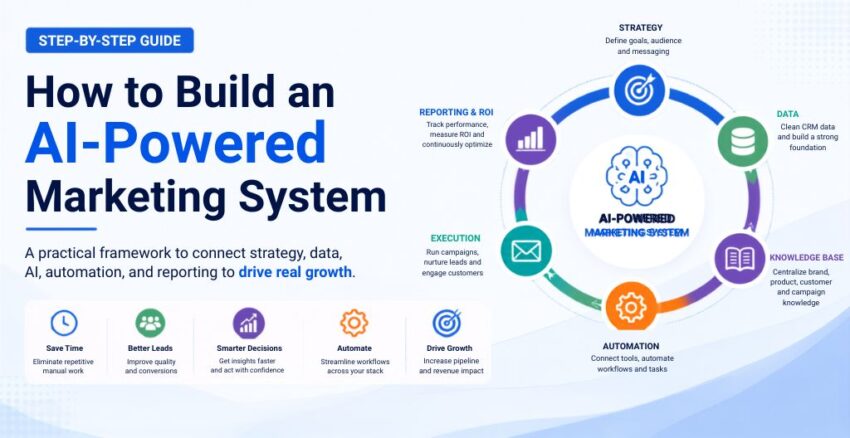
Building an AI-powered marketing system is not about adding one more chatbot to your workflow.
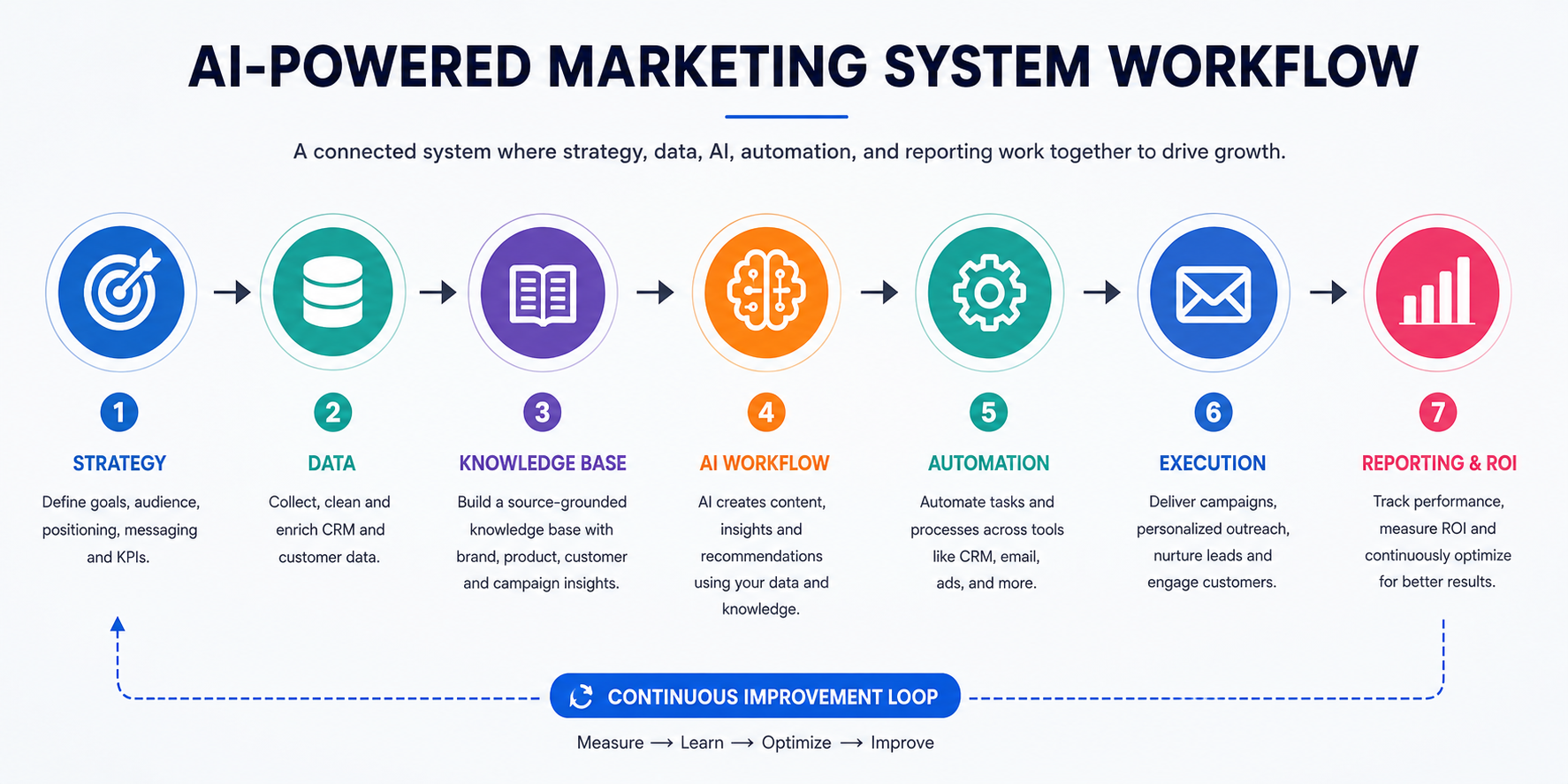
It is about moving from scattered tools, random prompts, and disconnected campaigns to a connected marketing operating system. In a real AI-powered marketing system, your strategy, data, content, CRM, automation, reporting, and human judgment work together.
A random AI tool helps you finish a task. A proper AI-powered marketing system helps you run marketing with more speed, clarity, and control.
What This Guide Covers
- What is an AI-powered marketing system?
- Why most AI marketing systems fail
- Step 1: Define strategy and messaging first
- Step 2: Audit your existing workflow
- Step 3: Clean your CRM and data foundation
- Step 4: Build a source-grounded knowledge base
- Step 5: Train AI on brand voice and workflow rules
- Step 6: Choose your automation engine
- Step 7: Follow the three-stage maturity roadmap
- Step 8: Define the human-AI division of labor
- Step 9: Build a weekly quality control routine
- Step 10: Measure AI marketing ROI
Quick Answer: What Is an AI-Powered Marketing System?
An AI-powered marketing system is a connected workflow where AI supports research, content creation, campaign planning, lead management, automation, reporting, and optimization. It uses clean data, clear messaging, source-grounded knowledge, human review, and automation tools to improve marketing execution without losing strategy or brand quality.
Why Most AI Marketing Systems Fail
Most AI marketing systems fail because teams start with tools before fixing strategy, data, and workflows.
They buy subscriptions. They test prompts. They create a few content drafts. Then the excitement fades because nothing meaningful changes in the marketing engine.
The problem is not AI. The problem is that AI gets added on top of broken systems.
If the CRM is messy, AI will personalize campaigns using poor data. If the brand message is unclear, AI will create generic content. If the sales handoff is weak, AI will only move bad leads faster.
| Adoption Blocker | What It Means | How to Fix It |
|---|---|---|
| Trust blocker | Teams do not know how AI reached its output. | Show sources, rules, and review checkpoints. |
| Control blocker | Leaders worry that AI will publish wrong or off-brand content. | Keep human approval for sensitive outputs. |
| Workflow blocker | Teams do not know where AI fits into daily execution. | Map workflows before adding automation. |
AI adoption is not only a tool problem. It is a trust, workflow, and governance problem.
Step 1: Define Strategy and Messaging First
Strategy comes first because AI can only scale the clarity that already exists in your marketing system.
The biggest mistake marketers make is starting with tools. They ask, “Which AI tool should I use?” But that is the wrong first question.
The better question is, “What marketing system am I trying to build?”
Before choosing any AI tool, define your positioning, audience, offer, message, funnel stages, and KPIs. AI is leverage. It is not the strategy.
- Who are we targeting?
- What problem do we solve?
- Why should buyers trust us?
- What action do we want prospects to take?
- What does a qualified lead look like?
- What KPIs matter to sales and leadership?
If your messaging is unclear, AI will only create unclear content faster.
Step 2: Audit Your Existing Marketing Workflow
A workflow audit shows where AI can remove manual work without breaking your existing marketing process.
Once your strategy is clear, map your current workflow. Do not jump into automation yet.
First, document how marketing actually works today across lead generation, content creation, email campaigns, paid campaigns, CRM updates, sales handoff, reporting, follow-ups, and campaign reviews.
Then ask where the team is wasting time, where data is getting lost, where leads are dropping, and where reporting becomes painful.
Do not automate everything. Pick the painful process first.
Step 3: Clean Your CRM and Data Foundation
Clean data gives AI the context it needs to personalize, route, score, and report marketing activity accurately.
AI systems fail when data is messy. If your CRM has duplicate contacts, inconsistent lead sources, missing campaign fields, outdated lifecycle stages, and unclear owner fields, AI will make bad decisions faster.
| Data Area | Why It Matters |
|---|---|
| Lead source | Helps track which channels create pipeline. |
| Lifecycle stage | Helps AI understand where the buyer is. |
| Industry | Helps with segmentation and personalization. |
| Company size | Helps with lead scoring and routing. |
| Campaign name | Helps reporting and attribution. |
| Owner field | Helps sales handoff. |
| Opportunity value | Helps connect marketing activity to revenue. |
You do not need perfect data on day one. But you need usable data.
Step 4: Build a Source-Grounded Knowledge Base
A source-grounded knowledge base helps AI create outputs using your own brand, product, customer, and campaign information.
Most marketers use AI like this: open a chatbot, type a prompt, copy the answer, and move on.
That is the prompt-and-copy trap. It may help with quick tasks, but it does not create a marketing system.
A better approach is to build a source-grounded knowledge base. This can include brand guidelines, past campaigns, customer FAQs, sales call notes, competitor research, blog briefs, product pages, case studies, CRM insights, and campaign reports.
This is where tools like NotebookLM content marketing workflow, private knowledge bases, or RAG-based systems become useful.
A source-grounded AI system creates better briefs, stronger content, more accurate summaries, and cleaner campaign ideas.
Step 5: Train AI on Brand Voice and Workflow Rules
Brand voice training prevents AI from creating generic content that sounds polished but forgettable.
AI needs direction. If you do not define your brand voice, AI will choose one for you. Usually, that voice sounds safe, generic, and forgettable.
Create a simple brand voice document with approved copy examples, phrases to avoid, tone rules, audience details, and content formats.
The Prompt Formula I Use for AI Marketing Workflows
A good AI prompt is not just a sentence. It is a structured instruction.
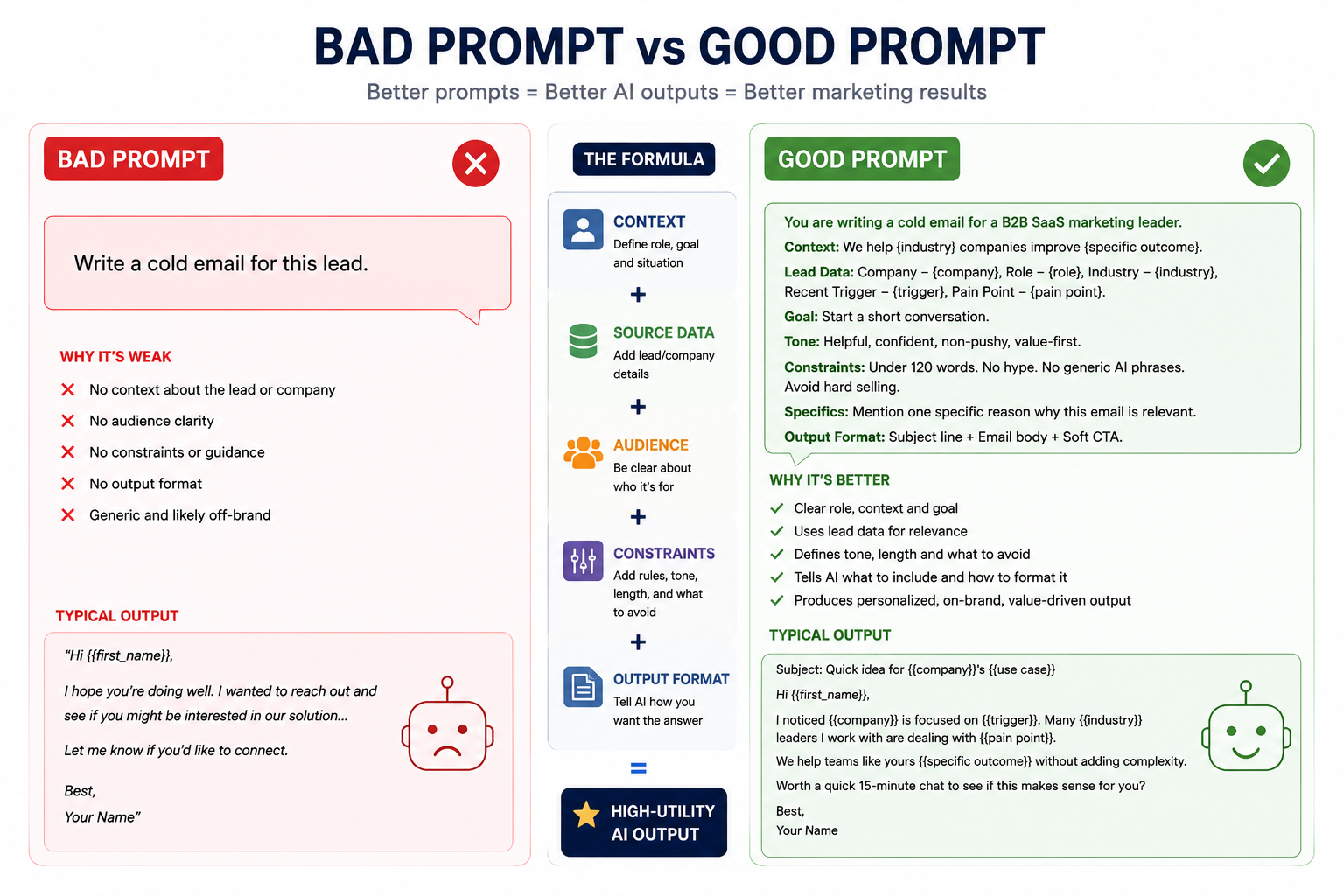
Bad prompt:
Better prompt:
For more examples, read my guide on AI prompts for B2B marketers.
Step 6: Choose the Right Automation Engine
The right automation engine connects your AI, CRM, email, analytics, and campaign tools into one working system.
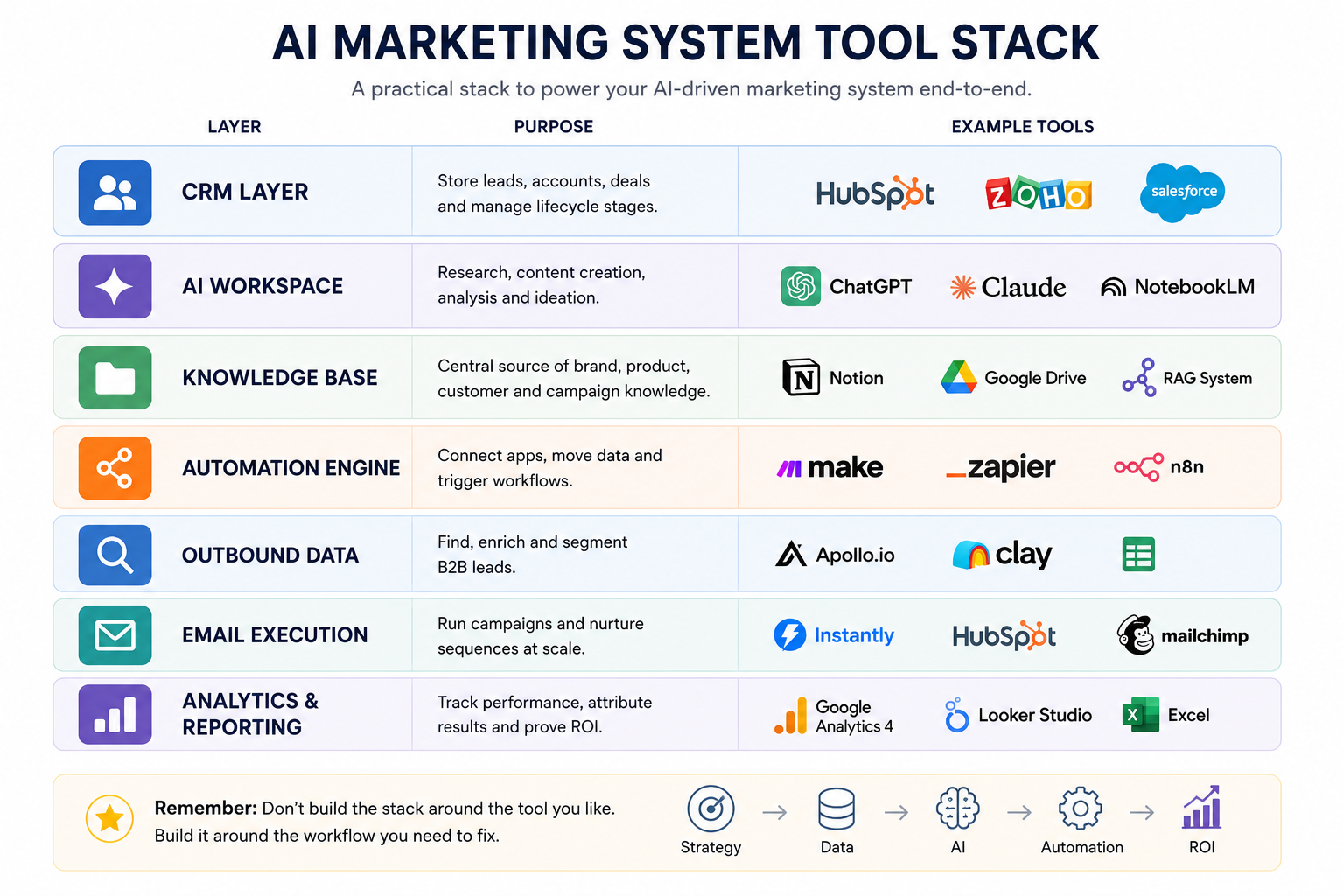
Once your knowledge base and data foundation are ready, choose your automation engine. This could be Zapier, Make, n8n, HubSpot workflows, Salesforce automation, or a custom system.
If you are comparing automation tools, my full Make vs Zapier vs n8n guide will help you choose the right workflow engine.
| Layer | Tool Examples | Purpose |
|---|---|---|
| CRM | HubSpot, Zoho, Salesforce | Store leads, accounts, deals, and lifecycle stages. |
| AI Workspace | ChatGPT, Claude, NotebookLM | Research, briefs, content, and analysis. |
| Knowledge Base | NotebookLM, Notion, Google Drive, RAG system | Store brand, product, customer, and campaign knowledge. |
| Automation Engine | Make, Zapier, n8n | Move data between tools and trigger workflows. |
| Outbound Data | Apollo, Clay | Find, enrich, and segment B2B leads. |
| Email Execution | Instantly, HubSpot, Mailchimp | Send campaigns and nurture sequences. |
| Analytics | GA4, Looker Studio, CRM reports | Track performance and ROI. |
Do not build the stack around the tool you like. Build it around the workflow you need to fix.
Step 7: Follow the Three-Stage AI Marketing Roadmap
A maturity roadmap helps teams adopt AI in stages instead of trying to automate everything at once.
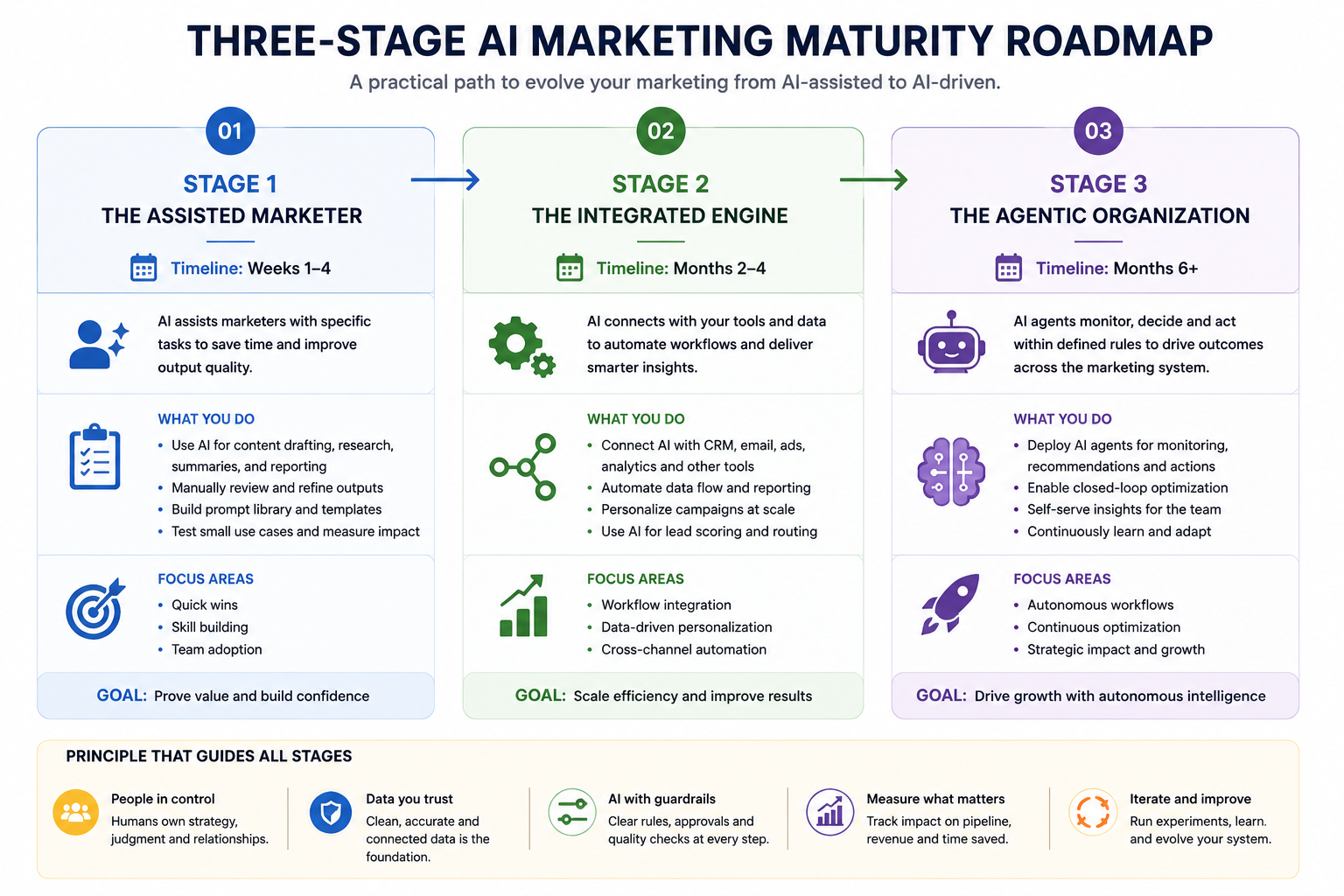
The Assisted Marketer
Timeline: Weeks 1–4
At this stage, AI helps with one or two defined tasks such as blog outlines, campaign reports, email variations, SEO briefs, or content repurposing.
The Integrated Engine
Timeline: Months 2–4
At this stage, your tools begin to connect. CRM data informs personalization, AI summarizes campaign performance, and lead source data flows into reporting.
The Agentic Organization
Timeline: Month 6 onward
At this stage, AI agents can monitor, recommend, and in some cases take action within clear rules.
Step 8: Define the Human-AI Division of Labor
The human-AI division of labor protects strategy, judgment, and relationships while AI handles speed and repetition.
AI should not do everything. A strong AI-powered marketing system clearly defines what AI handles and what humans own.
| Task | AI Handles | Human Owns |
|---|---|---|
| Campaign writing | Drafts variations. | Chooses message and angle. |
| Reporting | Finds anomalies. | Decides action. |
| Research | Summarizes patterns. | Finds opportunity. |
| Lead routing | Applies rules. | Reviews quality. |
| Content planning | Suggests topics. | Sets strategy. |
The rule is simple. AI handles volume, repetition, and analysis. Humans handle judgment, empathy, strategy, positioning, and relationships.
Step 9: Build a Weekly Quality Control Routine
A weekly QA routine prevents hallucinations, brand dilution, and automation errors from spreading across campaigns.
AI can sound confident even when it is wrong. That is why quality control is essential.
10 Minutes: Factual Control
Pick three AI-generated outputs and check stats, product claims, pricing, feature details, customer examples, and competitor references.
5 Minutes: Brand Control
Read the output aloud. Ask whether it sounds like your company or like generic AI content.
5 Minutes: Strategic Control
Ask whether anything changed this week that AI does not know. If yes, update your knowledge base.
Step 10: Add Ethical and Legal Guardrails
AI guardrails protect customer trust, brand credibility, data privacy, and campaign quality.
An AI marketing system should not ignore trust. You need clear rules for data, privacy, and content ownership.
- Use customer data responsibly.
- Prioritize zero-party data where possible.
- Avoid invasive personalization.
- Review AI-generated claims before publishing.
- Keep humans involved in final approvals.
- Respect copyright and source usage.
- Work with legal and compliance teams early.
How to Measure AI Marketing ROI
AI marketing ROI should be measured through time saved, better lead quality, faster decisions, and pipeline contribution.
Do not measure your AI system only by how many drafts it creates. That is a vanity metric.
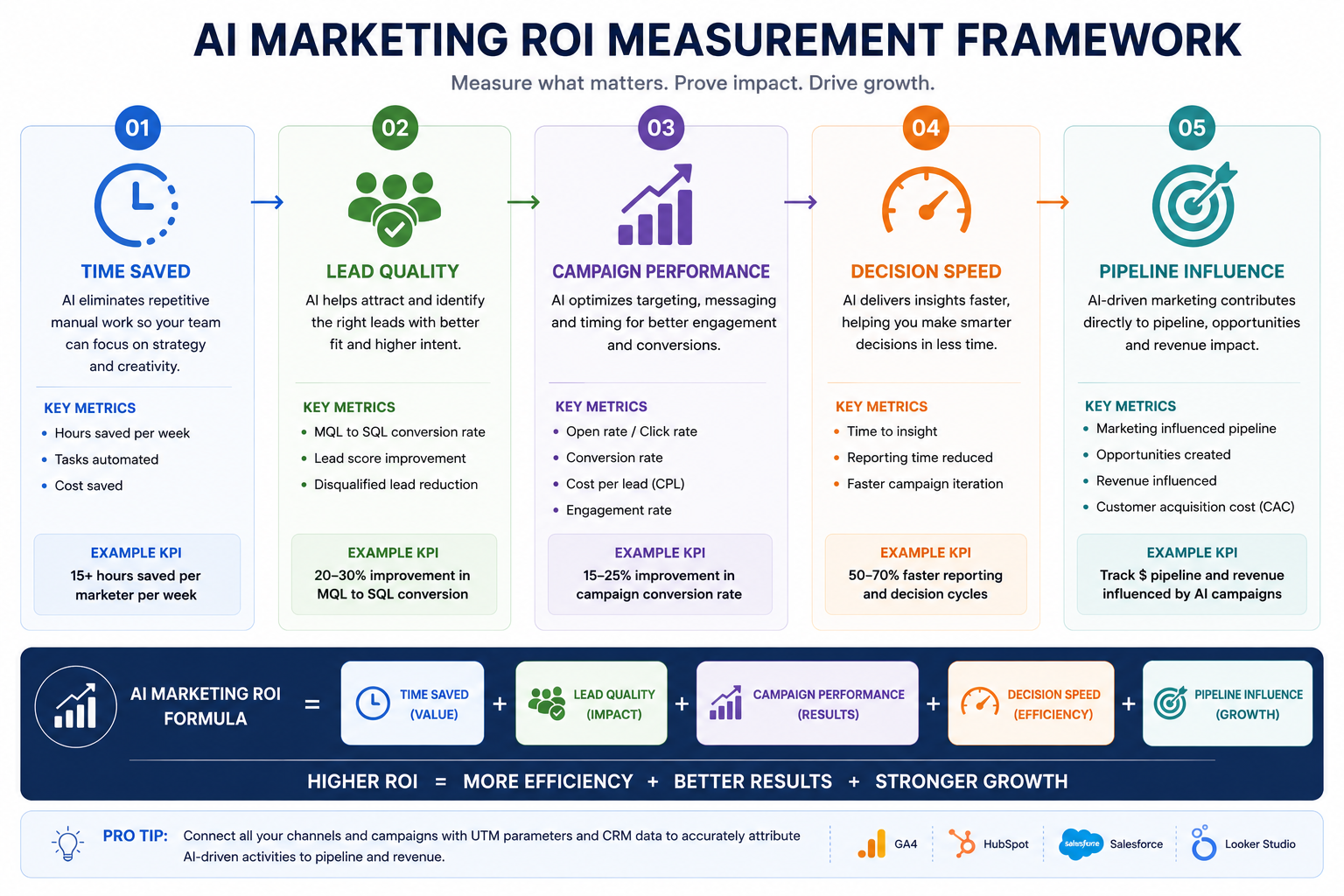
If you want to connect campaign activity with revenue impact, my guide on marketing ROI using GA4 explains the reporting side in detail.
| ROI Area | What to Measure |
|---|---|
| Time saved | Hours reduced in reporting, research, writing, and repurposing. |
| Campaign performance | CPL, conversion rate, lead quality, and email engagement. |
| Decision speed | How fast insights become actions. |
| Pipeline influence | How AI-supported campaigns contribute to MQLs, SQLs, opportunities, and revenue. |
Common Mistakes to Avoid
The biggest mistake is using AI to scale confusion instead of clarity.
- Starting with tools before strategy.
- Automating broken workflows.
- Using AI without clean CRM data.
- Treating AI as a writing shortcut only.
- Ignoring human review.
- Creating tool sprawl.
- Failing to train teams properly.
- Measuring vanity metrics.
- Publishing robotic communication.
- Forgetting governance and compliance.
If outbound is part of your AI system, compare your Instantly vs Apollo vs Clay setup before adding more AI automation.
Do not use AI to scale confusion. Use AI to scale clarity.
Zero-Click Executive Summary
- An AI-powered marketing system is not one chatbot. It is a connected operating system for strategy, data, content, automation, and reporting.
- Start with messaging and workflow clarity before choosing tools.
- Clean CRM data is the foundation. Dirty data creates bad automation.
- Use a source-grounded knowledge base so AI works from your own brand, product, and customer information.
- Choose tools based on workflow fit, not hype.
- Keep humans involved in strategy, judgment, approvals, and sensitive decisions.
- Measure AI marketing ROI through time saved, lead quality, campaign performance, decision speed, and pipeline influence.
FAQs
What is an AI-powered marketing system?
An AI-powered marketing system is a connected workflow where AI supports research, content, automation, CRM, reporting, and optimization. It helps marketing teams execute faster while keeping strategy, data, and human judgment connected.
How do I start building an AI-powered marketing system?
Start by defining your strategy, messaging, audience, and KPIs. Then audit your workflows, clean CRM data, build a knowledge base, and automate one high-friction process first.
What tools are needed for an AI marketing system?
Common tools include a CRM, email platform, analytics tool, automation engine, AI workspace, knowledge base, and reporting dashboard. The best stack depends on your workflow, team skills, and business goals.
Can AI replace marketing strategy?
No. AI can speed up research, writing, reporting, and automation, but it cannot replace positioning, judgment, empathy, and strategic decision-making.
How do you measure AI marketing ROI?
Measure AI marketing ROI through time saved, campaign performance improvements, lead quality, pipeline influence, and decision speed.
Conclusion
Building an AI-powered marketing system is not about chasing the newest AI tool. It is about creating a smarter marketing operating system.
Start with strategy. Clean your data. Build a source-grounded knowledge base. Train AI on your brand voice. Connect your tools. Define where humans stay in control. Then improve the system through small experiments.
That is how AI becomes useful in marketing. Not as a shortcut. Not as a random chatbot. As a connected growth system.

Want to Collaborate?
Open to guest posts, partnerships, link collaborations, and marketing discussions. If you’re building something interesting, let’s connect.
Connect on LinkedIn