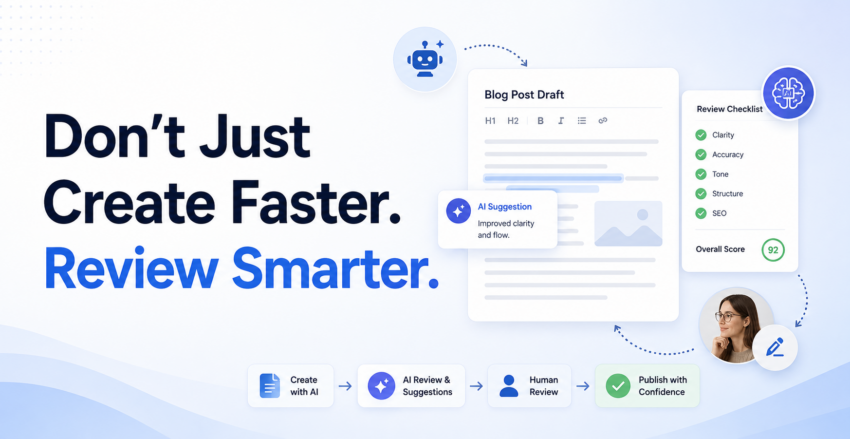
Most teams are not struggling because AI writes badly.
They are struggling because nobody reviews AI properly.
An AI content review workflow gives your team a clear process to turn AI-generated drafts into accurate, useful, brand-safe content. It defines what AI can draft, what humans must check, who approves the final output, and how content moves from idea to publishing without losing quality.
This matters more now because AI use at work has moved fast. Microsoft and LinkedIn’s 2024 Work Trend Index found that 75% of knowledge workers were already using AI at work, and 46% had started within the previous six months. In India, the figure was even higher, with 92% of knowledge workers using AI at work.
That is the reality.
AI is already inside the content workflow.
The question is whether your review process has caught up.
How to Build an AI-Powered Marketing System Step-by-Step
An AI-powered marketing system is a connected workflow where AI supports research, content creation, campaign planning, lead management, automation, reporting, and optimization. It uses clean data, clear messaging, source-grounded knowledge, human review, and automation tools to improve marketing execution without losing strategy or brand quality.
Quick Answer: What Is an AI Content Review Workflow?
An AI content review workflow is a structured process for checking, editing, approving, and publishing AI-assisted content. It helps teams review facts, brand voice, tone, SEO, originality, compliance, and business context before the content goes live. The goal is simple: let AI speed up drafting, but keep humans responsible for quality and final approval.
Table of Contents
- Why AI Content Needs a Review Workflow
- What Should an AI Content Review Workflow Check?
- Step 1: Define What AI Can and Cannot Create
- Step 2: Create a Brand Voice Review Layer
- Step 3: Add a Factual Accuracy Check
- Step 4: Review SEO and Search Intent
- Step 5: Add Human-in-the-Loop Approval
- Step 6: Build a Simple Content Review Checklist
- Step 7: Measure Workflow Quality and ROI
- Common Mistakes to Avoid
- FAQs
30 AI Prompts for B2B Marketers I Use Every Week
The best AI prompts for B2B marketers include role, ICP, channel, task, and output format. Use them weekly for content, outbound, SEO, campaign planning, reporting, and sales enablement to save 5–6 hours per week.
Why AI Content Needs a Review Workflow
AI content needs a review workflow because speed without control creates risk.
AI can help with outlines, drafts, summaries, repurposing, and headline ideas. But AI does not understand your brand history, sales context, customer objections, product limits, or sensitive business details unless you give it that context.
That gap creates problems.
A draft may sound polished but still be wrong. It may include generic claims. It may miss search intent. It may use a tone that feels unlike your brand. It may mention facts without source checks. It may also create content that is technically acceptable but strategically useless.
For B2B marketing teams, that is a real issue.
Your content is not just “content.” It supports pipeline, trust, sales conversations, product education, and market positioning.
Deloitte’s research on trust in generative AI highlights risk management actions such as training users, keeping inventories of AI implementations, setting governance frameworks, running audits, and making sure humans validate AI-created content. That is the mindset marketers need to bring into content operations.
The goal is not to slow AI down.
The goal is to stop weak content from moving fast.
What Should an AI Content Review Workflow Check?
An AI content review workflow should check accuracy, source quality, brand voice, SEO, structure, originality, legal risk, audience fit, and business usefulness.
Here is the simple split.
| Review Area | What to Check | Owner |
|---|---|---|
| Factual accuracy | Stats, claims, names, dates, product details | Editor or subject expert |
| Brand voice | Tone, clarity, personality, banned phrases | Content lead |
| SEO | Primary keyword, search intent, title, H2s, meta | SEO/content owner |
| AEO readiness | Direct answers, FAQs, clear definitions, tables | Content strategist |
| Compliance | Sensitive claims, legal risk, privacy issues | Legal/compliance if needed |
| Business value | Does it help the buyer make a decision? | Marketing lead |
| Final approval | Publish or reject | Owner or reviewer |
This table should sit inside your content process. Not in someone’s head.
If the review process is unclear, every reviewer will use their own standards. That is how AI content becomes inconsistent.
Step 1: Define What AI Can and Cannot Create
AI should support repeatable content tasks, but humans should own the final message, point of view, and approval.
Start by defining AI’s role.
Do not tell your team, “Use AI for content.”
That is too vague.
Instead, create three content zones.
AI Can Create the First Draft
AI can help with:
- Blog outlines
- Meta descriptions
- FAQ drafts
- Social post variations
- Newsletter drafts
- Webinar summary notes
- Blog repurposing
- Topic clusters
- Content brief drafts
- First-pass email copy
This is safe because a human still reviews the output before it is published.
AI Can Assist, But Not Own
AI can support:
- Messaging options
- Landing page copy
- Product explainers
- Lead nurture emails
- Sales enablement drafts
- Competitive comparisons
- Case study outlines
Here, the content needs more human judgment. A product marketer, sales leader, or subject expert should review the final message.
AI Should Not Publish Without Strict Review
Be careful with:
- Legal claims
- Healthcare, finance, insurance, or security claims
- Pricing details
- Customer proof points
- Competitor claims
- Product roadmap language
- Data privacy statements
- Executive quotes
AI may help prepare the draft, but a legal, compliance, product, or subject expert should validate the final content.
This is where AI can help prepare a draft, but the review bar must be higher.
IBM’s 2026 research on enterprise AI control found that many organizations still lack visibility across AI dependencies, which can create risk when AI tools, vendors, models, and infrastructure move faster than traditional governance.
For marketers, the lesson is simple.
Do not let AI content move without ownership.
This is where a clear human-AI marketing workflow helps. It defines what AI handles and where humans must stay involved.
Step 2: Create a Brand Voice Review Layer
A brand voice review layer checks whether AI-assisted content sounds like your company, not like a generic AI draft.
This is the most common failure I see.
AI content often sounds correct but forgettable.
It uses phrases like:
- “unlock growth”
- “drive transformation”
- “seamless experience”
- “empower teams”
- “leverage AI”
- “game-changing solution”
The problem is not grammar.
The problem is lack of personality.
A good brand voice review layer should check:
- Does this sound like us?
- Would our sales team say this?
- Is the tone too formal?
- Is the claim too broad?
- Is the intro generic?
- Are we saying something specific?
- Is there a real point of view?
- Did we remove filler?
For my own content, I use a simple filter:
If the line sounds like any other B2B company could say it, rewrite it.
That one rule improves AI content quickly.
Simple Brand Voice Checklist
| Check | Question |
|---|---|
| Clarity | Can a busy marketer understand this fast? |
| Specificity | Does it include real examples or decision points? |
| Tone | Does it sound human and confident? |
| Originality | Does it say something beyond common advice? |
| Sharpness | Can we cut 20% of the words? |
AI can draft.
A human gives it edge.
Step 3: Add a Factual Accuracy Check
A factual accuracy check verifies every claim, stat, product detail, feature, price, and source before content goes live.
This step is non-negotiable.
AI can create confident sentences from weak or incomplete information. That is dangerous for B2B content because buyers often use your blogs to judge your credibility.
Check these items before publishing:
- Statistics
- Dates
- Product names
- Feature claims
- Pricing references
- Customer examples
- Competitor comparisons
- Tool capabilities
- Legal or compliance statements
- Any “best,” “first,” “largest,” or “only” claim
Use a simple rule:
No source, no stat.
This protects your content from becoming another pile of confident guesswork.
When you use data, cite original or credible sources. For example, workplace AI adoption stats should come from sources like Microsoft Work Trend Index, LinkedIn, Gartner, McKinsey, Deloitte, IBM, or original research reports.
Do not use random summaries when the original report is available.
Step 4: Review SEO and Search Intent
An AI content review workflow should check whether the draft answers the searcher’s real question, not just whether it includes keywords.
Many AI drafts are keyword-rich but intent-poor.
That means they mention the right phrases but fail to solve the actual problem.
For this blog, the primary keyword is AI content review workflow. But the user behind that search is not looking for theory. They want a process.
They may be asking:
- How do we review AI content before publishing?
- Who should approve AI-generated drafts?
- What should our AI content checklist include?
- How do we avoid off-brand AI content?
- How do we keep humans involved without slowing everything down?
Your SEO review should check:
- Is the primary keyword in the title?
- Is it in the first 100 words?
- Does the intro clearly state the problem?
- Do H2s match real search questions?
- Are there tables or checklists?
- Are FAQs useful?
- Does the content answer “how” and not only “what”?
- Are internal links added naturally?
Also, review AEO readiness.
Answer engines like ChatGPT, Gemini, and Perplexity prefer content that gives direct answers, clean definitions, structured steps, tables, and practical examples.
So do not write one long essay.
Structure the content so it can be quoted, summarized, and trusted.
Step 5: Add Human-in-the-Loop Approval
Human-in-the-loop approval means AI can create or suggest content, but a human reviews and approves it before it reaches the audience.
This is the heart of the workflow.
A simple approval flow can look like this:
- Content brief created.
- AI drafts outline.
- Human reviews angle and structure.
- AI drafts first version.
- Editor checks tone, facts, SEO, and flow.
- Subject expert reviews accuracy.
- Final approver checks business risk.
- Content is published.
- Performance is reviewed.
- Learnings feed back into prompts and templates.
This creates speed without losing control.
For small teams, one person may handle multiple roles. That is fine. The point is not to add bureaucracy. The point is to make the review process visible.
Review Roles
| Role | Responsibility |
|---|---|
| Writer | Creates or improves the draft |
| Editor | Checks flow, voice, clarity, and structure |
| SEO owner | Checks search intent and optimization |
| Subject expert | Checks accuracy and nuance |
| Final approver | Owns risk and publishing decision |
A human-in-the-loop process helps teams scale content without handing the brand over to automation.
For a practical source-grounded content setup, read how I use NotebookLM content marketing workflow to organize research, briefs, prompts, and content ideas.
Step 6: Build a Simple Content Review Checklist
A content review checklist turns AI editing from opinion into a repeatable process.
Here is a practical checklist you can use.
AI Content Review Checklist
| Review Item | Pass/Fail |
|---|---|
| Primary keyword appears naturally in the first 100 words | |
| Search intent is clear in the intro | |
| Article has one H1 | |
| H2s are clear and useful | |
| Facts and stats have credible sources | |
| Product claims are accurate | |
| Brand voice feels human and specific | |
| Generic AI phrases are removed | |
| Passive voice is low | |
| Examples are practical | |
| Internal links are added naturally | |
| CTA is relevant | |
| FAQ section answers real questions | |
| Schema is added | |
| Image alt text includes the primary keyword or close variation | |
| Final approver has reviewed it |
This checklist does two things.
First, it improves quality.
Second, it reduces arguments.
Instead of saying “this feels weak,” you can point to the specific issue.
The intro is generic.
The stat has no source.
The CTA is too early.
The keyword is forced.
The section does not answer the search intent.
That is how content review becomes useful.
Step 7: Measure Workflow Quality and ROI
The ROI of an AI content review workflow should be measured through speed, quality, consistency, traffic, conversion, and reduced rework.
Do not measure AI content only by volume.
Publishing more content is not a win if the content is weak.
Track better metrics:
| KPI | What It Tells You |
|---|---|
| Draft turnaround time | Is AI reducing first-draft effort? |
| Editing time | Are prompts and templates improving? |
| Review rejection rate | Is AI producing usable drafts? |
| Factual error count | Is the review process catching risk? |
| SEO performance | Are pages ranking and getting impressions? |
| Engagement | Are readers staying and clicking? |
| Conversion | Are CTAs generating leads or subscribers? |
| Repurposing speed | Is one asset creating more useful formats? |
If you want to connect content performance with business impact, my guide on marketing ROI using GA4 explains how to report campaign results in a way leadership understands.
For B2B teams, connect content performance to business outcomes where possible.
Examples:
- Blog assisted newsletter signups
- Blog drove tool comparison clicks
- Blog influenced demo page visits
- Blog supported LinkedIn engagement
- Blog created recruiter or founder conversations
- Blog supported sales follow-up
If you publish content only to fill a calendar, AI will make the calendar bigger.
If you publish content to support pipeline, AI becomes more useful.
Common Mistakes to Avoid
Mistake 1: Letting AI Write Without a Brief
AI needs context.
Without a brief, it guesses.
A good content brief should include:
- Target reader
- Search intent
- Primary keyword
- Buyer stage
- Pain point
- Angle
- Internal links
- CTA
- Tone rules
- Examples to include
- Claims to avoid
Mistake 2: Reviewing Only Grammar
Grammar is the lowest level of review.
You also need to review:
- Accuracy
- Brand voice
- Search intent
- Business logic
- Examples
- CTA relevance
- Trust
A grammatically correct article can still be useless.
Mistake 3: Publishing Generic AI Intros
AI often starts with broad openings.
Cut them.
Start with the real problem.
Weak intro:
In today’s digital world, AI is changing how marketers create content.
Better intro:
Most teams are not struggling because AI writes badly. They are struggling because nobody reviews AI properly.
That second version has a point.
Mistake 4: Using AI for Final Judgment
AI can suggest.
A human should decide.
This matters most for positioning, claims, sensitive topics, and customer-facing content.
Mistake 5: Not Updating Prompts After Review
Every review should improve the next draft.
If editors keep fixing the same issues, update the prompt, template, or source material.
The workflow should learn.
FAQs
What is an AI content review workflow?
An AI content review workflow is a process for checking, editing, approving, and publishing AI-assisted content. It helps teams review accuracy, brand voice, SEO, compliance, and business value before content goes live.
Why does an AI content review workflow matter?
It matters because AI can create content quickly, but speed alone does not guarantee quality. A review workflow protects your brand from inaccurate claims, generic tone, weak structure, and off-message publishing.
What should be included in an AI content review checklist?
A checklist should include factual accuracy, source quality, brand voice, SEO, search intent, originality, compliance, CTA relevance, internal links, schema, and final human approval.
Who should approve AI-generated content?
The approver depends on the content type. Blog posts may need an editor and SEO owner. Product pages may need product marketing. Legal, healthcare, finance, or security topics may need compliance or subject expert review.
Can AI content rank on Google?
AI-assisted content can rank when it is useful, accurate, original, and created for people. The review process should improve quality, add expertise, remove generic text, and make the content genuinely helpful.
How do you measure AI content workflow ROI?
Measure draft turnaround time, editing time, factual error count, review rejection rate, organic traffic, engagement, conversion, and lead quality. Do not measure success only by the number of drafts created.

Want to Collaborate?
Open to guest posts, partnerships, link collaborations, and marketing discussions. If you’re building something interesting, let’s connect.
Connect on LinkedIn