A few months ago, we reviewed a campaign that looked “successful” on paper.
Traffic was up. Leads were growing. CPL looked stable.
But CAC kept rising.
That’s the problem most B2B teams face today.
If you’re looking at AI tools that reduce CAC in B2B marketing, you’re not trying to optimize content. You’re trying to fix the system behind acquisition.
And here’s the reality.
CAC doesn’t increase because you spend more.
It increases because your funnel leaks.
Why CAC Gets Too High in B2B
Let’s break this down from what I’ve seen in real teams.
Not theory. Execution.
| Problem | What Happens | Impact on CAC |
|---|---|---|
| Poor targeting | Wrong audience enters funnel | Low conversion |
| Weak lead quality | Sales chases bad leads | Wasted effort |
| Slow follow-up | Leads lose intent | Drop-offs increase |
| Broken handoff | MQL ≠ SQL | Pipeline friction |
| Low conversion | Leads don’t move forward | Higher cost per deal |
Now here’s the catch.
Most teams try to fix this by adding more top-of-funnel.
More ads. More content. More tools.
That makes CAC worse.
What AI Actually Fixes
AI doesn’t magically reduce CAC.
It removes waste.
And waste is what drives cost.
Let’s make this practical.
| AI Capability | What It Changes | Real Outcome |
|---|---|---|
| Lead targeting | Filters better accounts | Higher quality pipeline |
| Lead scoring | Prioritizes real buyers | Better conversion |
| Personalization | Improves engagement | Higher response rates |
| Sales insights | Identifies deal risks | Faster decisions |
| Automation | Removes manual tasks | Lower operational cost |
👉 Notice something?
None of this is about content.
It’s about efficiency.
The Framework We Actually Used to Reduce CAC
Here’s the framework we’ve used across campaigns.
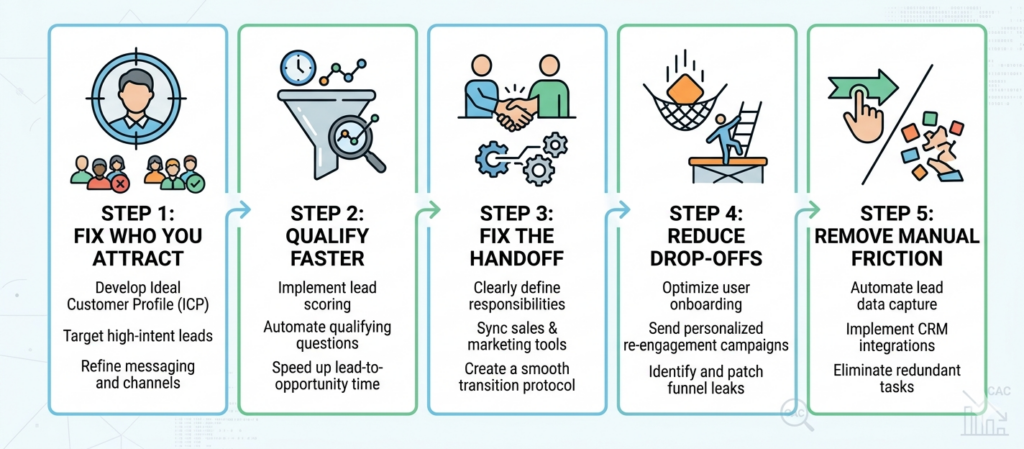
Step 1: Fix who you attract
Before AI, most targeting is guesswork.
With AI, you refine:
- ICP
- intent signals
- account behavior
👉 Result: fewer but better leads
Step 2: Qualify faster
This is where most CAC gets wasted.
AI lead scoring helps answer:
👉 “Is this worth sales time?”
| Without AI | With AI |
|---|---|
| All leads treated equally | Leads prioritized |
| Manual qualification | Automated scoring |
| Slow response | Fast routing |
👉 Result: higher conversion, lower CAC
Step 3: Fix the handoff
This is where marketing and sales break alignment.
AI helps define:
- when a lead is ready
- what sales should do next
👉 Result: fewer lost opportunities
Step 4: Reduce drop-offs
This is invisible in most dashboards.
But it kills CAC.
AI helps:
- trigger follow-ups
- personalize communication
- track engagement
👉 Result: more deals move forward
Step 5: Remove manual friction
Your team is expensive.
Don’t waste it.
AI handles:
- data enrichment
- CRM updates
- outreach sequences
👉 Result: same team, more output
AI Tool Categories That Actually Reduce CAC
Now let’s connect this to tools.
Not random tools.
The ones that map to the framework.
| Category | What It Fixes | Impact on CAC | When You Need It |
|---|---|---|---|
| Lead Scoring | Lead quality | Higher conversion | Too many low-quality leads |
| Prospecting | Targeting accuracy | Better-fit pipeline | Wrong audience entering funnel |
| CRM Automation | Workflow efficiency | Lower operational cost | Manual work slowing teams |
| Sales Intelligence | Deal insights | Higher win rates | Deals not closing |
| Analytics | Pipeline visibility | Better decisions | No clarity on CAC drivers |
Tools I Recommend (Based on Use Case)
I don’t recommend tools based on features. I recommend them based on where your CAC is leaking.
Here are tools I’ve seen work across real B2B setups.
| Use Case | Recommended Tools | Why It Works | Pricing |
|---|---|---|---|
| Lead Scoring | HubSpot, 6sense | Improves lead quality and prioritization | $$–$$$ |
| Prospecting | Apollo, ZoomInfo | Better targeting = lower wasted spend | $$–$$$ |
| CRM Automation | Salesforce, HubSpot | Faster deal movement and less manual work | $$–$$$ |
| Sales Intelligence | Gong, Clari | Improves win rates and forecasting | $$$ |
| Analytics | Power BI, Tableau | Identifies where CAC is leaking | $$ |
Some links in this article may become affiliate partnerships. I only recommend tools I’ve used or seen deliver real results in B2B environments.
How to Measure If CAC Is Actually Dropping
Most teams measure activity.
That’s the mistake.
Measure this instead:
| Metric | What It Tells You |
|---|---|
| Cost per qualified lead | Lead quality |
| Lead → opportunity rate | Funnel strength |
| Opportunity → close | Sales effectiveness |
| Sales cycle length | Speed of revenue |
| CAC payback period | Business health |
👉 If these improve, CAC drops.
Where Teams Get This Wrong
Let’s keep this honest.
Most teams fail here:
- They buy tools before fixing process
- They use AI on bad data
- They automate poor messaging
- They focus only on content
- They ignore sales alignment
AI doesn’t fix bad strategy.
It amplifies it.
Final Take
The biggest shift I’ve seen:
- Teams that win don’t use more AI tools.
- They use fewer tools, but in the right places.
If you’re exploring AI tools that reduce CAC in B2B marketing, don’t start with tools.
- Start with your leaks.
- Fix those.
- Then layer AI.
FAQ
Which AI tools reduce CAC in B2B marketing?
Ans: Tools focused on lead scoring, targeting, and sales intelligence deliver the biggest impact.
How do AI tools lower CAC?
Ans: They improve efficiency across targeting, qualification, and conversion stages.
What is the fastest way to reduce CAC?
Ans: Improve lead quality and conversion rate before increasing spend.
Are AI tools enough to fix CAC?
No. They support systems. They don’t replace them.
What should I measure first?
Ans: Start with cost per qualified lead and conversion rates.

Want to Collaborate?
Open to guest posts, partnerships, link collaborations, and marketing discussions. If you’re building something interesting, let’s connect.
Connect on LinkedIn